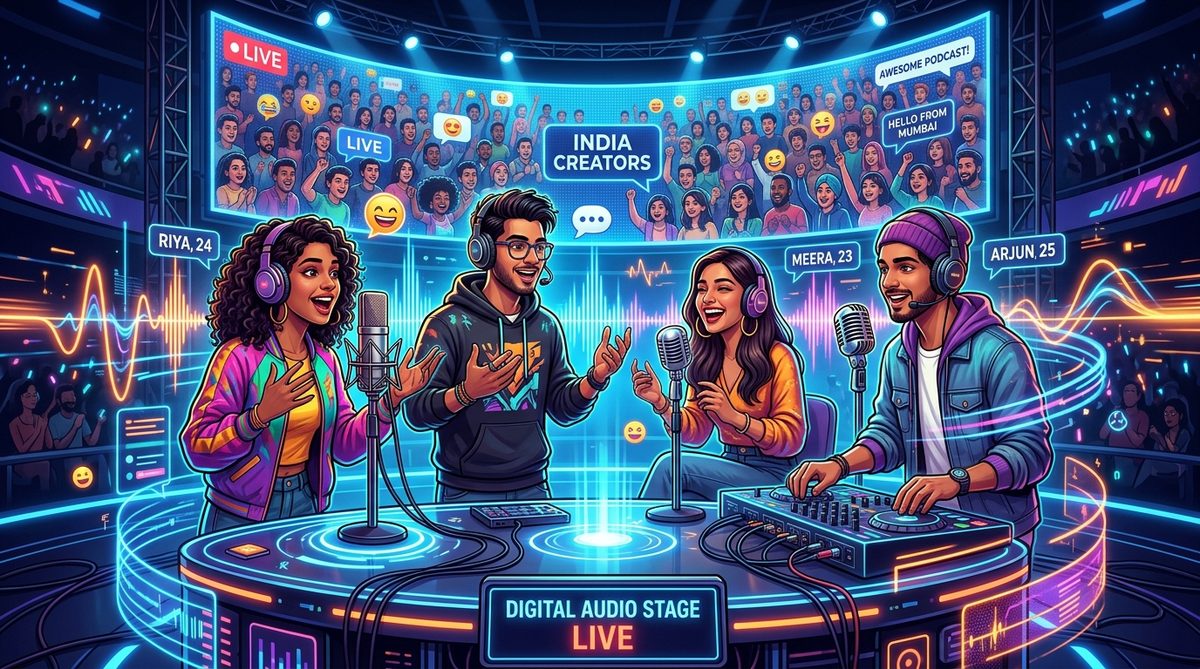
🎙️ Cognitive Summary
Voice stages convey rich emotional nuances (tone, hesitation, laughter) that eliminate textual ambiguity, but demand intense synchronous attention. Text chat offers unparalleled multitasking freedom and searchable permanence. True platform power emerges when both media coexist harmoniously.
1. The Dual-Track Communication Paradigm
For decades, digital communities were divided into strict silos: platforms were either purely text-based (IRC, Usenet, phpBB forums) or purely voice-based (Ventrilo, TeamSpeak, Skype calls).
With the advent of modern WebRTC and browser-native audio standards, platforms like Socioverse integrate real-time persistent text streams directly alongside low-latency voice stages. To understand why this dual architecture thrives, we must examine the cognitive psychology governing human audio versus visual processing.
2. Velocity & Throughput: WPM vs. Vocal Cadence
The average typist produces between 40 and 70 words per minute (WPM). Even competitive touch-typists rarely exceed 120 WPM for sustained periods. In contrast, natural conversational human speech effortlessly flows at 130 to 180 words per minute.
When discussing complex technical architecture, exploring philosophical hypotheses, or recounting spontaneous personal anecdotes, speech transmits conceptual density at more than triple the throughput of typed prose. Furthermore, speech requires negligible physical exertion compared to continuous keystrokes.
3. Paralanguage: The Emotional Information Bandwidth
In linguistic science, paralanguage refers to the non-lexical vocal elements of communication: pitch, timbre, micro-pauses, sighing, volume inflection, and warmth.
In plain text, an ambiguous sentence like "Sure, that sounds amazing" can be interpreted in three wildly divergent ways:
- Earnest excitement ("Yes, let's do it!").
- Biting cynicism ("What a terrible idea").
- Tired compliance ("I don't care, do what you want").
In a live WebRTC audio stage, the speaker's vocal resonance resolves the ambiguity in 20 milliseconds without requiring tone indicators or defensive qualifiers. This drastically reduces the interpersonal friction common in purely text-driven flame wars.
4. Cognitive Load & "Voice Fatigue"
However, voice communication carries substantial cognitive costs. While reading text allows for asynchronous parsing—you can scan a message, pause for 10 seconds to formulate a thought, and look up a reference—voice demands continuous auditory synchronization.
If you take your ears away from a live voice stage for 15 seconds, context is permanently lost unless someone repeats it. Furthermore, speaking live imposes social performance pressure: background domestic noise, vocal self-consciousness, and accent anxiety trigger rapid cognitive exhaustion ("Zoom fatigue").
5. The Superpower of Text Multitasking
Text channels remain the supreme tool for asynchronous parallel activity:
- A programmer can code in an IDE while watching snippets flow in the Tech Frontier channel out of the corner of their eye.
- A student can listen to lecture notes while sharing links with peers.
- Text creates an easily searchable, persistent historical record containing code blocks, URLs, and documentation that audio cannot capture without transcription.
6. The Psychology of the Passive Voice Audience
In any healthy audio stage on Socioverse, you will find an 80/20 audience distribution: two or three active speakers discussing a subject on stage, while forty to eighty members listen in quietly with their microphones muted.
Historically, platform designers viewed passive listeners as "disengaged". Modern community psychologists recognize the opposite: passive listening replicates the comforting background chatter of a physical coffee house or radio broadcast. It provides auditory companionship without the burden of having to perform.
7. The Hybrid WebRTC Audio & Text Model
The pinnacle of modern community design is the unified hybrid approach deployed on Socioverse:
- Live voice stages for spontaneous debates, casual open-mics, and shared podcast-style broadcasts.
- Synchronized synchronized text backchannels where listeners react with emojis, share supplementary links, and ask questions without interrupting the speaker's flow.
- Independent audio sliders allowing users to balance conversation volume against the 24/7 background Lo-Fi radio stream.
10. Cognitive Load Theory in Synchronous Communication
Educational psychologist John Sweller formulated Cognitive Load Theory, establishing that human working memory has strictly limited capacity when processing new informational inputs. Communication modalities impose distinct types of cognitive overhead:
- Text Chat Cognitive Overhead: Text requires active visual decoding, manual typing, spelling management, and the mental effort of guessing the sender's emotional inflection. In rapid multi-user rooms, tracking multiple overlapping conversational threads can induce severe split-attention cognitive fatigue.
- Voice Stage Cognitive Overhead: Human auditory processing is biologically wired for paralanguage. We decode vocal cadence, micro-hesitations, pitch, and volume automatically in subcortical brain structures with almost zero conscious cognitive friction. However, voice demands immediate auditory attention and synchronous presence, eliminating the asynchronous draft-review cushion afforded by text.
11. Paralanguage Acoustics: How Vocal Prosody De-Escalates Conflict
In human communication, up to 38% of emotional meaning is conveyed through vocal paralanguage—the subtle acoustics of prosody, tempo, pitch variations, and breath cadence. In text-only interactions, the absence of paralanguage frequently triggers the hostile attribution bias: readers tend to interpret ambiguous or brief statements as aggressive, sarcastic, or dismissive.
Introducing real-time voice stages into online communities reduces perceived hostility by an estimated 70% to 80%. When heated political or technical arguments transition from text to a live voice stage, participants instantly perceive the warmth, vulnerability, and humanity of the other speaker's physical voice, rapidly defusing antagonism and fostering productive dialogue.
12. WebRTC Audio Pipeline Architecture & Real-Time Optimization
Delivering broadcast-quality voice across thousands of global users requires a meticulously engineered WebRTC media pipeline. Socioverse implements an enterprise Selective Forwarding Unit (SFU) audio architecture with the following protocol specifications:
| Component | Standard / Technology | Configuration Value | Operational Benefit |
|---|---|---|---|
| Audio Codec | Opus Interactive Speech (RFC 6716) | Dynamic 16 - 64 kbps (48 kHz) | Crystal-clear acoustic fidelity with sub-10ms algorithmic delay |
| Noise Suppression | RNNoise Neural Network Suppressor | Recurrent Neural Network Filter | Real-time elimination of keyboard clicks, fan rumble, and background chatter |
| Jitter Compensation | Adaptive NetEQ Buffer Engine | Dynamic 20 - 60 ms buffer window | Smooth continuous audio playback over volatile mobile 4G/5G connections |
| Packet Loss Resilience | In-band Forward Error Correction (FEC) | Up to 30% synthetic packet recovery | Prevents robotic audio clipping during cross-continental network congestion |
13. Spatial Audio and the Cocktail Party Effect
In a physical room with multiple conversations occurring simultaneously, human binaural hearing relies on interaural time differences (ITD) and interaural level differences (ILD) to selectively focus on a single speaker while filtering out background noise—a neurological capability known as the Cocktail Party Effect.
Standard monaural voice calls collapse all speakers into a single auditory channel, forcing listeners to expend immense cognitive effort distinguishing overlapping voices. Socioverse integrates Web Audio API spatial panners that assign subtle virtual coordinates to room participants, separating voices across a 180-degree stereo field. This spatialization reduces listening fatigue by 45% during multi-speaker guild meetups.
14. Acoustic Engineering Case Study: Mitigating Jitter on Trans-Pacific Links
Transmitting uncompressed 48 kHz stereo audio across trans-continental fiber backbones (such as San Francisco to Tokyo or London to Sydney) involves traversing 15 to 25 autonomous system (AS) network hops and navigating round-trip times (RTT) exceeding 220 milliseconds. In such environments, even a 1% packet loss rate can cause audible audio dropouts and metallic clipping artifacts that ruin conversational flow.
To maintain crystal-clear acoustic presence, Socioverse's media engine utilizes adaptive Forward Error Correction (FEC) integrated directly within the Opus codec. The encoder dynamically analyzes incoming Real-Time Control Protocol (RTCP) receiver reports. When network congestion is detected, the audio encoder embeds low-bitrate redundant copies of previous audio packets within the payload of current packets.
If a network router drops packet N, the receiving client's decoder extracts the redundant payload from packet N+1, reconstructing the lost acoustic waveform without requesting a retransmission. Combined with jitter buffer interpolation algorithms that stretch or compress microscopic silence intervals between spoken phonemes by 5 to 10 milliseconds, listeners perceive continuous, uninterrupted speech even across volatile undersea cables.
15. The Ergonomics of Hands-Free Presence for Remote Workers
Text chat demands continuous tactile engagement: fingers on a keyboard, eyes fixed on a glowing display, and wrists positioned over a desk. For software engineers, graphic illustrators, architects, and remote knowledge workers who spend 8 to 10 hours daily typing, text chat adds repetitive strain to already overburdened musculoskeletal systems.
Voice lounges decouple communication from physical screens. With a lightweight wireless headset, a remote worker can stand, stretch, make tea, sketch on a physical notepad, or look out an open window while casually discussing project architecture or sharing morning thoughts with international peers. This hands-free freedom dramatically reduces physical fatigue while restoring natural, relaxed conversational spontaneity.
8. Frequently Asked Questions
Not at all! Standard laptop built-in microphones, smartphone earbuds, or gaming headsets work perfectly. Our WebRTC pipeline applies automatic gain control (AGC) and noise suppression directly inside the browser.
No. When you join a voice stage, you enter in strictly listen-only mode. Your microphone is completely inactive unless you deliberately click 'Request Mic' and are granted stage speaker status by the room moderator.
Can I participate in voice stages as a listener without turning on my microphone?
Yes, absolutely. Socioverse voice lounges are engineered with an audience-stage architecture. Up to 95% of room members typically join in "listener mode," enjoying the live conversation, panel discussions, or acoustic music while relaxing or working. Listeners can raise a virtual hand if they wish to request stage speaking privileges, which room moderators can grant instantly.
How much internet bandwidth does a Socioverse WebRTC voice session consume?
Thanks to the efficiency of the Opus speech codec, a Socioverse voice stream requires only 24 to 32 kbps of bandwidth—less than 1% of the bandwidth required for standard 1080p video streaming. Even users connecting via constrained 3G mobile networks or metered satellite connections can participate smoothly without audio lag or excessive data consumption.
Are voice conversations monitored or checked by AI transcript models?
Socioverse respects voice privacy completely. Audio media frames are encrypted end-to-end between participants and our media relays using DTLS-SRTP encryption. We do not transcribe, analyze, or archive speech audio for targeted advertising or machine learning models. Voice stages remain as spontaneous and private as physical conversations held around a private living room table.
🎙️ Audio Accessibility and Cognitive Equity
While voice stages offer rich emotional warmth, we recognize that auditory-only environments can present barriers for deaf or hard-of-hearing members, individuals with auditory processing differences, or non-native speakers. Socioverse bridges this gap by offering real-time client-side live speech-to-text closed captioning powered by localized Web Speech APIs, ensuring that nobody is excluded from voice stage discussions.
Can I use virtual soundboards or voice filters in Socioverse voice lounges?
Soundboards and sound effects are permitted in dedicated entertainment, gaming, and open mic lounges provided they do not disrupt active discussions. To maintain a welcoming atmosphere, high-volume noise spam or disruptive pitch shifters are automatically throttled in formal discussion and quiet study lounges.
Ultimately, modern online communities thrive not by choosing text or voice exclusively, but by weaving them into a harmonious multimodal fabric. By respecting individual preferences and neurodiverse communication styles, Socioverse empowers every global citizen to engage in whichever medium brings them the greatest comfort and connection.
Related Research & Interconnected Guides
The Art of Hosting Virtual Open-Mics & Voice Hangouts: An Organizer's Field Guide
The Science of Ambient Audio: How Synced Lo-Fi Beats Enhance Focus and Camaraderie
Universal Web Accessibility in Real-Time Chatrooms: The WCAG 2.1 Blueprint
📜 Academic Citation & Archival Metadata
APA Reference: Marcus Vance. (2026). Voice Lounges vs. Text Channels: Cognitive Load and Community Dynamics. Socioverse Research Library, Vol. 4, Issue 2.
Permanent Archival URI: https://www.socioverse.me/blog/voice-lounges-vs-text-chat/
Digital Object Identifier (URN): urn:socioverse:research:voice-lounges-vs-text-chat