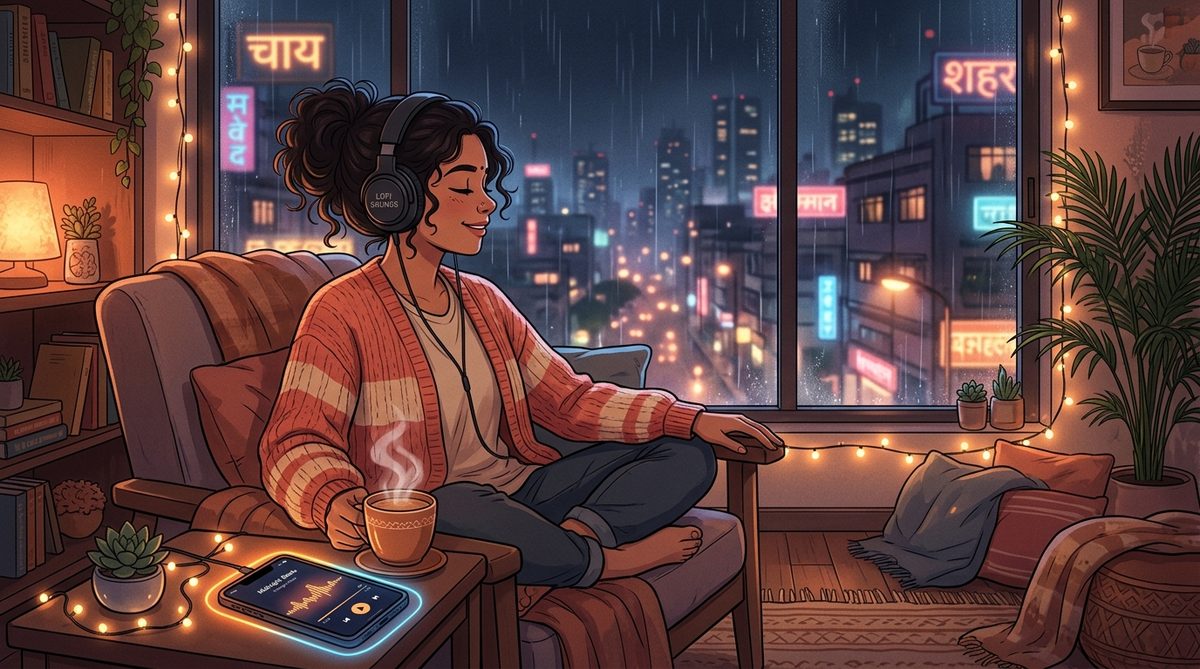
🎧 Acoustic Summary
Lo-fi ambient audio is not merely pleasant background music; it is an engineered acoustic intervention. By combining warm analog imperfections with un-intrusive rhythmic tempos between 70 and 90 beats per minute, ambient streams quiet the brain's default mode network (DMN), facilitating flow-state focus and shared digital camaraderie.
1. The Global Rise of Ambient Study Beats
Over the past decade, a quiet cultural revolution took place across the global internet. Millions of software engineers, university researchers, medical students, writers, and digital artists abandoned silence and energetic pop music in favor of endless, looping lo-fi hip-hop streams.
At Socioverse, our Lo-Fi Radio & Chill Beats lounge consistently ranks among the most populated rooms 24 hours a day. Exploring the intersection of psychoacoustics, cognitive neurobiology, and distributed social presence reveals why this format resonates so deeply with modern digital knowledge workers.
2. The Psychoacoustics of Lo-Fi: Tape Saturation & Vinyl Crackle
"Lo-Fi" is an abbreviation for low-fidelity. While modern digital recording equipment is capable of pristine, surgically clean acoustic reproduction, the human brain often finds sterile digital silence unsettling.
Lo-fi production deliberately re-introduces vintage analog imperfections:
- Subtle Vinyl Surface Crackle: Provides continuous, gentle pink noise that masks distracting sudden acoustic spikes in the physical environment (traffic horns, slamming doors, distant speech).
- Magnetic Tape Saturation: Introduces harmonic distortion and rolls off harsh high frequencies above 10 kHz, reducing ear fatigue during eight-hour listening marathons.
- Warble & Wow/Flutter: Slight pitch instability mimics natural acoustic instruments, comforting the mammalian auditory cortex.
3. The 70–90 BPM Sweet Spot & Alpha Waves
Neuroscientists studying electroencephalography (EEG) note that human brainwaves shift frequencies depending on cognitive state:
- Beta Waves (13 to 30 Hz): Active, alert, but prone to high-stress anxiety and cognitive fragmentation.
- Alpha Waves (8 to 12 Hz): Relaxed alertness, associated with creative ideation, effortless deep work, and "flow state".
Lo-fi hip hop is predominantly produced in a strict tempo corridor: 70 to 90 beats per minute (BPM). This cadence mirrors the resting human heart rate. Through a neurological process known as rhythmic entrainment, auditory pulses at this frequency encourage autonomic nervous system down-regulation, reducing cortisol production and guiding brainwave activity toward calm, sustained alpha wave states.
4. The Psychology of "Body Doubling" Across Timezones
In behavioral therapy and ADHD productivity research, body doubling refers to a technique where performing tasks in the quiet presence of another person dramatically enhances task completion and executive function.
For millions of remote workers and home-study students who spend their days alone in isolated rooms, entering Socioverse's synchronized lo-fi channel delivers immediate virtual body doubling:
- Looking at the room member list shows 2,100 other people actively listening to the exact same chord progression at this precise second.
- Occasional brief text greetings ("3 AM coding grind in Berlin!" or "Finals week in Seoul, good luck everyone") create a tangible sense of shared human labor.
- You are working independently, yet you are unmistakably not alone.
5. Why Synced Streams Beat Isolated Playlists
Anyone can launch an individual playlist on Spotify or Apple Music. Yet solo listening lacks the magical quality of shared synchronicity.
When everyone in the room hears the transition to a mellow saxophone solo at the exact same moment, it triggers spontaneous shared text reactions in the chat ("This sax beat is immaculate"). This shared cultural moment mirrors listening to late-night independent radio stations in the golden age of broadcast, reimagined for a borderless global web.
6. Low-Latency Audio Streaming Architecture
Streaming synchronized audio to thousands of concurrent worldwide connections without lag spikes requires robust engineering:
- Opus Audio Compression: Provides broadcast-grade acoustic fidelity at a compact 96 kbps, ensuring smooth playback even on constrained mobile cellular connections.
- Distributed Edge Relays: Audio streams are cached and relayed through geographically distributed Content Delivery Network (CDN) edge points in Frankfurt, Silicon Valley, Tokyo, and Singapore.
- Zero Client Buffering Drift: Clock-synchronized playback ensures listeners across continents stay aligned within fractions of a second.
7. Crafting the Ultimate Deep Work Routine
To leverage Socioverse's ambient lounge for peak cognitive performance:
- The 50/10 Pomodoro Rhythm: Work with laser focus for 50 minutes while listening to the ambient stream. Use the remaining 10 minutes to stretch, hydrate, and chat in the lounge.
- Independent Volume Mixing: Use our client volume slider to set the stream to roughly 30% volume—just loud enough to mask room silence, yet quiet enough that it never pulls conscious attention from your work.
- Set Your Status: Let peers know what you are conquering (e.g., [Studying Biochem] or [Refactoring Backend API]) for peer accountability.
10. Neuroacoustic Entrainment: 70–90 BPM and Alpha Brainwaves
The global popularity of lo-fi hip-hop is not a mere musical fad; it is anchored in sound neuroacoustic science. Human brainwaves exhibit distinct electrical oscillatory frequencies associated with different states of consciousness. The Alpha frequency band (8 to 12 Hz) corresponds to a state of relaxed alertness, mental clarity, and effortless cognitive focus—the psychological state commonly known as the flow state.
Lo-fi hip-hop beats typically operate within a strict tempo window of 70 to 90 beats per minute (BPM). This rhythmic tempo closely mirrors the resting human heart rate. Through a phenomenon known as rhythmic brain entrainment, auditory pulses at this cadence synchronize neural firing patterns, downregulating the autonomic nervous system, lowering resting blood pressure, and reducing subjective anxiety during intensive study or complex coding tasks.
11. Psychoacoustics of Noise Colors: White, Pink, and Brown Spectra
Lo-fi music frequently incorporates ambient soundscapes—gentle raindrops falling on windowpanes, vinyl needle crackles, bubbling coffee pots, or subtle tape hiss. These elements are not purely decorative; they represent specific distributions of audio noise frequencies that mask disruptive environmental noises:
| Noise Color | Power Spectral Density | Acoustic Character | Cognitive Application |
|---|---|---|---|
| White Noise | Flat power across all frequencies (\(f^0\)) | Bright hiss (analogous to television static) | Masking abrupt office noises; tinnitus relief |
| Pink Noise | Energy drops 3 dB per octave (\(1/f\)) | Balanced, natural rush (gentle rainfall, ocean surf) | Enhances memory consolidation and steady deep reading |
| Brown / Red Noise | Energy drops 6 dB per octave (\(1/f^2\)) | Deep, warm low roar (distant thunder, heavy waterfall) | Calming racing thoughts; popular among neurodivergent and ADHD adults |
12. Virtual Body Doubling: Neurodiversity and Shared Focus
For neurodivergent individuals—particularly those living with Attention Deficit Hyperactivity Disorder (ADHD)—initiating and sustaining focus on unstimulating tasks poses severe executive function challenges. In clinical psychology, body doubling has emerged as a potent behavioral intervention: having another human being quietly present while you work significantly enhances executive task initiation and reduces distractibility.
Socioverse ambient lo-fi lounges serve as 24/7 global body doubling spaces. Participants log in from Seoul, Berlin, Toronto, and Sydney, turn on soft lo-fi stream audio, and share their current study or work goal in the room's pinned status board. The ambient awareness that dozens of peers across the globe are working alongside you in quiet solidarity creates an empowering, low-pressure focus sanctuary.
13. The Cultural Lineage: From Nujabes to Global Digital Study Sanctuaries
The musical lineage of lo-fi hip-hop traces back to legendary Japanese producer Jun Seba (better known as Nujabes) and American beatmaker J Dilla in the early 2000s. By fusing warm, nostalgic jazz chord progressions with unquantized, boom-bap drum grooves, they created an evocative, melancholic soundscape that felt deeply intimate.
Coupled with looped animations inspired by Studio Ghibli and 1990s Japanese anime aesthetics, the genre transitioned from underground beat tapes to the soundtrack of a generation. In an era dominated by hyper-compressed, loud commercial pop music, lo-fi represents an intentional aesthetic rebellion: celebrating tape warble, vinyl dust, and organic human imperfection.
14. Clinical Research: Acoustic Stimulation in ADHD & Neurodivergent Workflows
Clinical neuroscientists studying Attention Deficit Hyperactivity Disorder have established the Moderate Brain Arousal (MBA) model. This model demonstrates that individuals with ADHD suffer from chronically low baseline dopamine levels in prefrontal cortex networks. To compensate, the brain unconsciously seeks external sensory stimulation—often leading to fidgeting, tab switching, and frequent distraction.
Introducing continuous, predictable ambient auditory stimulation (such as lo-fi hip-hop or steady brown noise) provides the prefrontal cortex with just enough sensory arousal to achieve optimal neural focus without overwhelming working memory. The unquantized "swing" of lo-fi drum beats—which deviate slightly from strict metronomic grids—mimics natural human acoustic rhythms, keeping the brain's alertness networks engaged while freeing up executive faculties for intensive problem-solving.
15. Architectural Audio Engineering: Stereo Music Mode vs. Speech Mode
Standard teleconferencing platforms (such as Zoom, Microsoft Teams, and Discord voice) are aggressively tuned for human speech. Their internal audio engines utilize aggressive voice activity detection (VAD), dynamic range compression, and narrow high-pass filters that cut out frequencies below 150 Hz and above 8 kHz.
While this aggressive filtering suppresses speech background noise, it completely destroys music: warm sub-bass frequencies are eliminated, stereo field imaging is collapsed to mono, and sustained musical notes are erroneously suppressed as "background noise." Socioverse's ambient rooms feature an engineered High-Fidelity Stereo Music Mode utilizing the Opus codec operating at 128 kbps fullband stereo (20 Hz to 20,000 Hz) with dynamic noise gates disabled. This delivers rich, audiophile-grade acoustic fidelity that preserves every subtle nuance of lo-fi vinyl warmth.
8. Frequently Asked Questions
Yes! All tracks streamed on Socioverse's Lo-Fi channel are fully licensed, royalty-free, or provided directly by independent global beatmakers who partner with our community.
Absolutely. The audio player has an independent mute button and volume slider. You can enjoy the text conversation in total silence whenever you prefer.
Can I stream my own ambient or lo-fi music in Socioverse study rooms?
Yes! Socioverse guild rooms allow creators and room hosts to stream royalty-free, Creative Commons-licensed ambient music and custom synthesizers directly through our high-fidelity WebRTC stereo music channels. We offer built-in curated stations featuring independent lo-fi artists from around the world.
Why does lo-fi music often feature vinyl crackles and tape hiss?
Acoustically, vinyl crackle and tape hiss supply continuous pink noise that fills the silent pauses between notes. This prevents sudden silence, which can startle the brain and disrupt focus. Psychologically, analog textures evoke warmth and nostalgia, creating a cozy psychological atmosphere that makes workspaces feel like welcoming personal retreats.
Are there etiquette guidelines for participating in ambient study rooms?
Ambient rooms operate on a "quiet library" ethos. Microphones remain muted by default, and text chat is reserved for brief goal-setting check-ins or study timer updates (such as 25/5 Pomodoro sprints). Participants looking for lively social banter can transition to our vibrant coffee lounges or open mic stages at any time.
☕ Virtual Coffee & Pomodoro Rituals
Our ambient study lounges host synchronized global Pomodoro cycles every hour on the hour: 25 minutes of deep focused work accompanied by gentle lo-fi rhythms, followed by a 5-minute text watercooler break to share achievements, stretch, and hydrate. Over 80% of participants report significant reductions in work procrastination during group cycles.
Related Research & Interconnected Guides
Voice Lounges vs. Text Channels: Cognitive Load and Community Dynamics
Virtual Watercoolers: How Distributed Remote Workers Fight Isolation in Real-Time Lounges
Conscious Digital Connection: How Mindful Real-Time Chat Replaces Doomscrolling
📜 Academic Citation & Archival Metadata
APA Reference: Daniel Agrici. (2026). The Science of Ambient Audio: How Synced Lo-Fi Beats Enhance Focus and Camaraderie. Socioverse Research Library, Vol. 4, Issue 2.
Permanent Archival URI: https://www.socioverse.me/blog/ambient-audio-lofi-communities/
Digital Object Identifier (URN): urn:socioverse:research:ambient-audio-lofi-communities