🌙 Psychological Core Insight
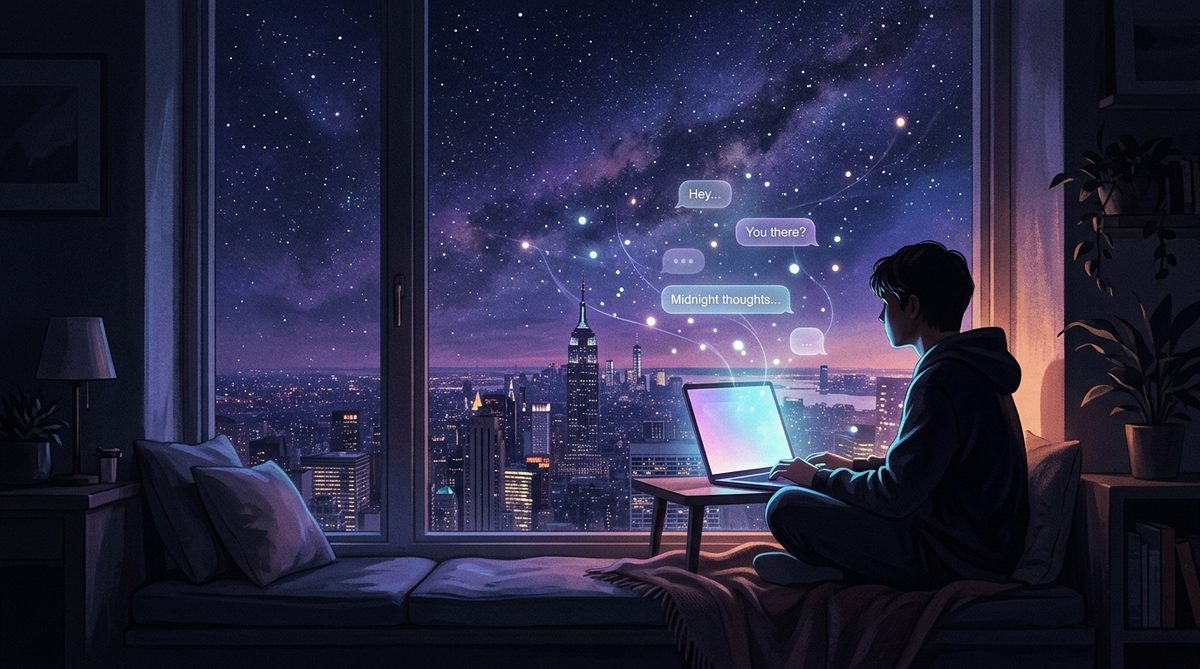
Late at night, cognitive fatigue lowers our performative social defenses. In the quiet hours between midnight and dawn, people stop broadcasting idealized self-images and start sharing genuine fears, unspoken hopes, and profound existential reflections.
1. The Magic of the Midnight Hour
Anyone who has frequented online communities over the last thirty years knows that a chatroom at 2:00 PM is a completely different psychological environment than the same room at 3:15 AM.
During daytime hours, conversation is dominated by transactional efficiency: sports updates, work complaints, link sharing, and quick memes. But as midnight passes, the conversational tempo decelerates. Messages lengthen. The rapid banter gives way to introspective philosophical dialogues, childhood memories, heartfelt confessions, and mutual emotional support. Why does nocturnal digital interaction feel so radically more authentic?
2. Prefrontal Cortex Disinhibition: Dropping the Mask
The primary driver of late-night authenticity is neurobiological. Throughout the waking day, the brain's prefrontal cortex (PFC)—the executive center responsible for impulse control, social risk assessment, and impression management—operates at peak metabolic capacity.
As fatigue accumulates late into the night, the prefrontal cortex experiences a natural downregulation known in cognitive psychology as hypofrontality. The hyper-vigilant internal editor that constantly whispers "Will this make me look uncool?" or "Is this too vulnerable?" grows tired. The social armor slips away, allowing raw emotional honesty to surface naturally in keystrokes.
3. Circadian Synchronization & The Insomnia Tribe
There is a profound sense of mutual kinship among people awake in the middle of the night. Whether someone is awake due to chronic insomnia, night shift nursing, late-night software compiling, or grief, looking at a chatroom and seeing hundreds of other souls creates an immediate circadian bond.
Users realize: "The rest of my physical neighborhood is asleep, but here in this glowing window, I am surrounded by fellow wanderers." That shared nocturnal solidarity establishes a baseline of empathy that daytime crowds rarely replicate.
4. The Acoustic Silence of the Physical World
During daylight hours, human attention is constantly assaulted by environmental sensory pollution: leaf blowers, traffic sirens, delivery couriers, Slack notifications, and office chatter.
At 3:00 AM, the physical world falls quiet. The sudden absence of ambient acoustic chaos clears cognitive bandwidth. With zero sensory distraction in their immediate physical room, a participant can direct 100% of their working memory into reading another person's paragraph and formulating a deeply considered response.
5. What We Talk About When the City Sleeps
In Socioverse's Night Owl Café and Mindful Sanctuary, nocturnal conversations cluster around timeless existential themes:
- Unrealized Ambitions: Career paths abandoned, creative projects left half-finished, and secret dreams people rarely mention to daytime coworkers.
- Existential Wonder: The vastness of the universe, astronomical physics, consciousness, and the subjective meaning of time.
- Vulnerability & Heartbreak: Processing past relationships, grief over lost family members, and navigating loneliness without fear of mockery.
6. The Global Timezone Paradox
One of the most fascinating aspects of Socioverse is the inter-timezone collision. When it is 3:30 AM in London or New York, it is 1:30 PM in Tokyo or Singapore.
A nocturnal Western night owl sitting in total darkness often converses directly with an Eastern student taking their midday lunch break under bright sunshine. This temporal juxtaposition produces breathtaking cross-cultural reflections on the nature of daily human life.
7. Moderating Nocturnal Channels: Empathy & Crisis Support
Because late-night hours are also when loneliness and emotional distress peak, Socioverse trains its nocturnal community guardians with specialized empathy protocols:
- Moderators act as calm listeners rather than punitive enforcers.
- If a participant exhibits signs of acute mental health crisis or self-harm ideation, guardians gently offer discreet 1-on-1 private links to certified 24/7 crisis support lines (such as 988 or Crisis Text Line).
- Toxicity and aggressive flame wars are halted instantly, preserving the sanctuary atmosphere of the room.
8. Balancing Nocturnal Fellowship with Circadian Health
While late-night chats provide irreplaceable emotional comfort, prolonged circadian disruption carries physical health costs. We encourage our community members to practice healthy boundaries:
- Use blue-light filtering or dark mode on your display.
- Set a firm 'bedtime curfew'—when the clock strikes 3:30 AM, wish your channel friends goodnight and log off.
- Remember that the community will be waiting for you tomorrow night.
10. Circadian Neurobiology: Melatonin & Prefrontal Downregulation
Why do conversations held between midnight and 4:00 AM feel profoundly different from midday discussions? The transformation is rooted in human chronobiology. As darkness falls, the suprachiasmatic nucleus (SCN) triggers the pineal gland to release melatonin, preparing the body for rest. Concurrently, metabolic activity in the dorsolateral prefrontal cortex (DLPFC)—the brain region responsible for executive control, strategic calculation, social self-monitoring, and cognitive filtering—declines significantly.
During daytime hours, the DLPFC operates at peak vigilance, constantly evaluating: "How will this statement affect my status? Does this make me look weak? Am I being judged?" At night, as executive inhibition recedes, individuals speak with spontaneous emotional transparency. Social facades drop, revealing raw hopes, existential doubts, and authentic creative musings that rarely surface during hectic daylight hours.
11. The "Mind After Midnight" Hypothesis: Vulnerability & Risk
In 2022, neuroscientists at Harvard Medical School and the University of Pennsylvania proposed the "Mind After Midnight" hypothesis. The researchers demonstrated that nocturnal circadian rhythms alter neurotransmitter balance (dopamine, serotonin, and norepinephrine), skewing cognitive processing toward heightened emotional valence and altered risk assessment.
While this heightened emotional receptivity can foster extraordinary poetic and interpersonal bonding, it also increases susceptibility to acute existential despair, loneliness, and impulsive rumination. In the absence of positive social outlets, isolated individuals late at night may spiral into self-critical thought patterns. Socioverse late-night lounges function as comforting virtual lighthouses, transforming solitary nocturnal hours into shared moments of human connection and mutual solace.
12. Nocturnal Sociodemographics: Who Inhabits Midnight Chatrooms?
The demographic tapestry of late-night digital spaces is exceptionally diverse:
- Third-Shift & Healthcare Workers: Nurses, factory technicians, paramedics, and security personnel who work nocturnal shifts and find physical cities shuttered when they are awake and seeking connection.
- Neurodivergent Night Owls: Individuals with Delayed Sleep Phase Syndrome (DSPS) or ADHD whose biological chronotypes naturally align with nocturnal creative flow states.
- Cross-Continental Wanderers: Global travelers, remote expatriates, and digital nomads seeking peers awake across opposite hemispheres.
- Insomniacs & Overthinkers: People wrestling with sleeplessness, personal grief, or major life crossroads who need a gentle, non-judgmental ear in the quiet hours.
13. Atmospheric Design for Nocturnal Digital Spaces
Late-night community spaces require deliberate sensory architecture. High-contrast white interfaces and jarring notification chimes shock the optic nerve, suppressing melatonin and inducing retinal strain. Socioverse late-night channels automatically transition into Midnight Mode: ultra-low luminance dark themes (deep charcoal `#141212` with soft indigo accents), suppressed notification sounds, and relaxed message rate limits that encourage slow, contemplative prose over frantic typing bursts.
14. Historical Precedent: Segmented Sleep and the Midnight Watch
Modern society operates under the assumption that unbroken 8-hour monophasic sleep is the natural biological state of humanity. However, extensive historical and anthropological research—most notably documented by historian A. Roger Ekirch in At Day's Close: Night in Times Past—reveals that prior to the Industrial Revolution and artificial gas lighting, humans practiced biphasic or segmented sleep.
People typically experienced a "first sleep" beginning shortly after dusk, followed by a natural waking period of 1 to 2 hours around midnight (known as "the watch"), before returning for a "second sleep" until sunrise. During this tranquil midnight interval, families shared intimate conversations by the hearth, philosophers composed poetry, and neighbors checked in on one another in a state of relaxed contemplative mindfulness.
Socioverse's late-night rooms inadvertently revive this ancestral psychological rhythm. In our hyper-connected, high-pressure modern lives, the quiet hours between midnight and dawn remain the only window where external demands vanish, allowing humans to rediscover the peaceful camaraderie that our ancestors enjoyed by the fireside centuries ago.
15. Hypnagogic Ideation and Creative Synchrony in Late-Night Salons
The cognitive transition between waking consciousness and sleep induces the hypnagogic state, characterized by increased theta brainwave activity (4 to 8 Hz). In this neurobiological state, associative semantic networks expand dramatically: the brain links previously disparate concepts, unlocking breakthroughs in creative writing, scientific hypothesis formulation, and artistic composition.
Our late-night creative lounges serve as real-time incubators for this nocturnal muse. Writers, software architects, visual artists, and musicians convene to workshop experimental ideas, finding receptive ears and spontaneous encouragement from international peers inhabiting the same nocturnal frequency.
9. Frequently Asked Questions
The 'Night Owl Café' and 'Mindful Sanctuary' are specifically dedicated to quiet, reflective midnight banter, accompanied by our 24/7 synchronized Lo-Fi Beats channel.
Yes! Because Socioverse is globally distributed across 85+ nations, voice stages host continuous conversations 24 hours a day as different timezones rotate through peak hours.
Why do late-night chat friendships often feel deeper than daytime interactions?
Late-night interactions benefit from the psychological principle of shared circumstance: both participants recognize that they are among the few souls awake in their respective worlds. Stripped of daytime distractions, competing professional demands, and defensive social posturing, conversations naturally gravitate toward existential, philosophical, and deeply personal themes.
How does Socioverse safeguard users who may experience mental health distress at night?
Our late-night lounges feature 24/7 volunteer guardians stationed across global timezones where it is daytime, ensuring calm, well-rested moderators are always present. Furthermore, automated sentiment heuristics detect expressions of despair and provide compassionate, confidential access to international crisis helplines.
Can participating in late-night chatrooms disrupt healthy circadian sleep hygiene?
Excessive screen exposure before bed can suppress melatonin. To support sleep hygiene, Socioverse features gentle "Time to Rest" reminders after 60 minutes of nocturnal chat and incorporates warm amber blue-light filtering modes to minimize sleep disturbance.
🌙 Midnight Lounge Philosophy
Our late-night channels are dedicated to slow, compassionate dialogue. Whether you are recovering from a grueling hospital shift, grappling with insomnia, or coding through an elusive algorithmic bug, Socioverse provides a warm, tranquil digital fireside where you are never alone in the quiet hours.
Are there designated quiet hours or slow-mode timers at night?
Yes. Between 00:00 and 06:00 local time, our midnight lounges automatically engage a gentle 10-second slow-mode timer. This discourages rapid-fire spamming and creates a relaxed, contemplative tempo that allows participants to read thoughtfully and compose deeply considered responses.
The nocturnal hours will always hold a mystical quality in human culture. By honoring the psychological vulnerabilities and profound creative opportunities of the midnight hours, Socioverse preserves a sanctuary where global citizens can share their authentic souls without pretense, judgment, or fear.
In a fast-paced world that never stops rushing, the midnight hours offer a rare gift: the opportunity to slow down, reflect deeply, and connect with fellow human beings in an atmosphere of warmth, vulnerability, and mutual care.
Related Research & Interconnected Guides
Combating Loneliness in the Digital Age: Finding Meaningful Friendships Online
The Future of Pseudonymous Identity: Why the Real-Name Web is Dying
Conscious Digital Connection: How Mindful Real-Time Chat Replaces Doomscrolling
📜 Academic Citation & Archival Metadata
APA Reference: Elena Rostova. (2026). The Psychology of Late-Night Chat: Why 3 AM Conversations Feel More Authentic. Socioverse Research Library, Vol. 4, Issue 2.
Permanent Archival URI: https://www.socioverse.me/blog/psychology-of-late-night-conversations/
Digital Object Identifier (URN): urn:socioverse:research:psychology-of-late-night-conversations